Zahin Sultan Hire me

Independent brand study · 2 Oct 2026

The promise got bigger than the proof.

Notion’s homepage now sells AI agents that keep work moving “24/7”. The brand earned its trust one block at a time. The proof that you can hand work to an agent safely is not on the page where the promise is made.

By Zahin Sultan · built from public sources and live observation

The evidence

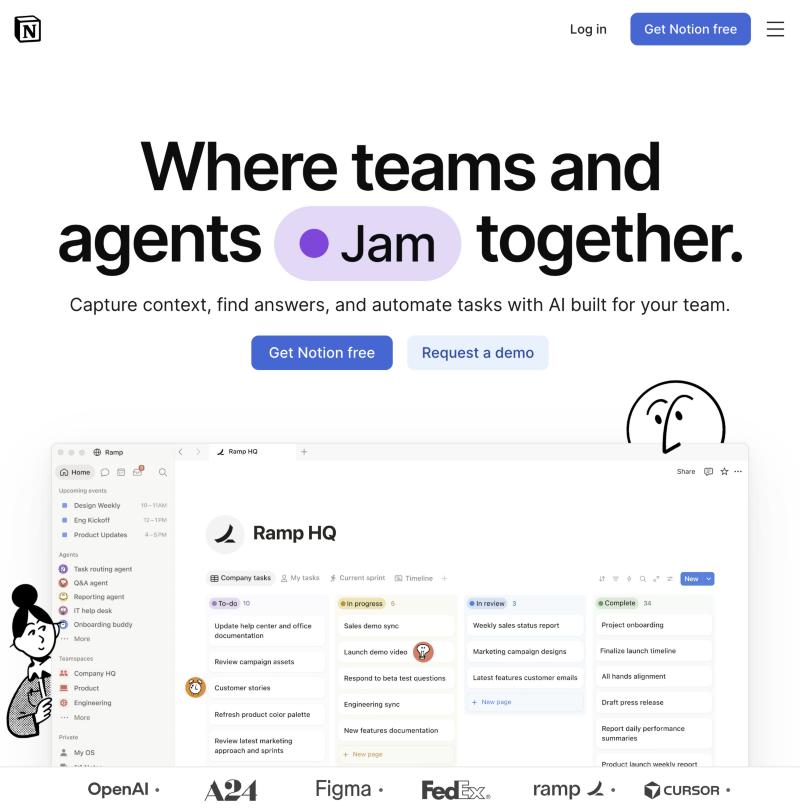
The hero, as it stood on 2 October.

Notion's homepage hero. Headline: Where teams and agents Jam together. Subhead: Capture context, find answers, and automate tasks with AI built for your team. Buttons: Get Notion free and Request a demo. Below it, a product screenshot of a company workspace.
Screenshot of notion.com, 2 Oct 2026. The highlighted verb in the headline rotates; I saw “Ship”, “Create” and “Jam”.
  1. The headline names “teams and agents”. The rotating verb is the playful, human part.
  2. The subhead says “AI built for your team”. A different phrase for the same idea.
  3. Two buttons of near-equal weight: a self-serve start and a sales demo.
  4. The product is shown doing company work: tasks, an agents list, a sprint board.

The verdict

A strong brand making a bigger bet.

What’s working

It shows the real product instead of abstract art. It uses a serif for human voices (customer quotes) and a sans for the system. The stats are strong, and the colour system is calm and warm: grays with a slight brown tint, one clear blue for action.

What’s at risk

One promise is said four ways on one URL. The hero is written for teams. And the bigger the autonomy being promised, the more visible the controls need to be. Today they sit elsewhere.

My one move

Pick one sentence for the promise and use it at every level. Add a visible “you’re in control” proof beside the agent claim, and give individuals a door.

What the brand says it is

The system, read from the source.

Colour, from notion.com’s own tokens

  • Action blue#0075DE
  • Warm gray 200#F6F5F4
  • Warm gray 300#DFDCD9
  • Warm gray 600#615D59
  • Warm gray 900#191918
  • Orange 200#FFDEC4

From the --tatami-color-* variables on the homepage. Notion’s grays carry a warm tint; they are not neutral.

Type, four voices

  • NotionInterInterface and headlines. A customised Inter.
  • Lyon TextCustomer quotes on the homepage: the human voice.
  • iA Writer MonoLoaded by the page. I did not see it rendered.
  • Permanent MarkerLoaded by the page. I did not see it rendered.

What the public guidelines cover

Notion’s public brand usage page is written for partners and community groups: how to name a product, a “Made for Notion” badge (minimum 48px tall), avatars and downloadable illustrations. On the page I read, I did not find public guidance on voice, typography or layout. Notion also asks that its logo not be used standalone to promote others, so this page does not use it.

What I found

Three findings, one thing to protect.

1

One promise, four phrasings.

What I saw. On a single URL, the same idea is worded four ways, and each names the product differently.

Why it matters. A brand is something other people can repeat. If the page title, the headline, the subhead and the section header each say something different, press, partners and Notion’s own sales team have four sentences to choose from and no single one to quote.

I could be wrong because the rotating verb suggests Notion is actively testing the hero, and title tags are often written for search rather than people.

Four phrasings of the promise on notion.com
WhereWhat it says
Page titleThe AI workspace that works for you.
HeadlineWhere teams and agents Create together.
Subhead…automate tasks with AI built for your team.
SectionAI where your team works.
2

The hero speaks to teams. The grassroots is individuals.

  • Triage product feedback
  • Resolve support tickets in Slack
  • Respond to security alerts faster
  • Automate weekly reporting
  • Create your own developer tools

What I saw. The subhead says “built for your team”. The second button is “Request a demo”. All five featured use cases are company workflows. Meanwhile Notion itself lists 1.4M+ community members as proof.

Why it matters. A person who wants a place for their own notes, plans or studies doesn’t find themselves in this hero. They may be exactly who recommends Notion at work later.

I could be wrong because there may be personal and student routes in the navigation, templates or a different entry page. I audited the homepage only.

3

Autonomy is promised. Control is out of sight.

What I saw. The page promises to “keep work moving 24/7 with agents”. In the page text, “security” appears in one use case (“Respond to security alerts faster”) and as a footer link. I found no mention of permissions, access or undo next to the agent claim.

Why it matters. Handing work to something that acts while you’re away is a trust decision. The more autonomous the promise, the closer the proof of control has to sit to it. Notion’s old strength was that you were always the author.

I could be wrong because the controls may be strong and well documented in product and on the Security page. My point is about where the proof sits, not whether it exists.

Claim“Keep work moving 24/7 with agents.”

Proof“Security”, a footer link

The fix · my proposal, not Notion’s

One sentence, three doors, visible control.

A

A message ladder

One idea, worded once, then repeated at every level. I kept the rotating verb because it is the best human moment on the page.

LevelTodayProposed
Page titleThe AI workspace that works for you.Notion: one workspace for your team and its agents.
HeadlineWhere teams and agents Create together.Where teams and agents create together. Keep it. It’s good.
SubheadCapture context, find answers, and automate tasks with AI built for your team.Your docs, projects and agents in one place. Agents only see and change what you give them access to.
ButtonsGet Notion free · Request a demoStart free (primary) · Talk to us (text link)

The access sentence is a proposal. It must be true of the product before it is written, so Notion’s product team would need to confirm it.

B

Three doors

Pick one. The sentence and the button change, because a person on their own and a company admin want different promises.

    C

    A control you can see

    The proof of control, shown beside the promise. This is a proposed component. Flip the switches.

    Weekly report agent

    Runs Mondays at 9:00 · last run 6 days ago

    • Can read the Roadmap
    • Can read the Support inbox
    • Can edit the Weekly report page
    • Asks me before sharing outside the workspace

    Design principle: every permission is a plain sentence, on by default only where needed, reversible in one click, and shown where the agent is introduced, not buried in settings.

    What I’d do first

    Three moves, tested before shipped.

    1. Run a five-second test

      Show the current hero and the proposed one. Ask what the product is and who it’s for.

      Measure Share of people who answer in one consistent sentence.

    2. Test the three doors

      Send a share of traffic to the door version, keeping the layout and product shot.

      Measure Sign-up to first page created, by door.

    3. Put the control card in the hero

      Place it beside the agent claim. Guard against slowing the page or crowding the headline.

      Measure Demo-request quality, and agent set-up completion.

    Method and limits

    How I know, and what I don’t.

    • Homepage only. I audited notion.com on 2 Oct 2026, from a US-based session. Pricing, product, onboarding and enterprise pages were not reviewed.
    • Rotating hero. The headline verb changes. Findings hold for any verb, but the page may be tested and changed.
    • Stats are Notion’s. I report them as claims, not facts.
    • Tokens and fonts were read from the page’s own CSS and computed styles.
    • No inside data. No analytics, interviews or usability testing.
    • Tools. Research and code were built with AI assistance. The analysis, judgment and recommendations are Zahin’s.

    Sources

    Notion is a trademark of Notion Labs, Inc. Named here only to identify the subject of commentary. This study is not affiliated with or endorsed by Notion.

    I do this for small brands, too.

    The Brand Starter Kit gives a business its positioning, identity, voice and a live site in three weeks, with a fixed price.