What’s working
A character-led brand that learners actually like, a tone that is unmistakable, and a product that is the best advertisement. Q2 2026 shows growth continuing after the 2025 backlash.
Independent brand study · 2 Oct 2026
Duolingo’s playful tone built one of the strongest brands in consumer software. In April 2025 it met a moment that wasn’t funny, and the playbook had no setting for it. Here is what that cost, and the rule that fixes it.
By Zahin Sultan · built from public sources and live observation

Shown for identification. Not affiliated with or endorsed by Duolingo.
The verdict
A character-led brand that learners actually like, a tone that is unmistakable, and a product that is the best advertisement. Q2 2026 shows growth continuing after the 2025 backlash.
Duolingo’s voice has one dominant setting. When a serious moment arrived, the visible choices were a joke or silence. Its own colour also fails contrast as text.
Write a four-step tone ladder with one rule: if a message touches someone’s money, job, safety or data, the mascot does not speak and a named human signs it.
What happened
CEO Luis von Ahn tells staff Duolingo will be “AI-first”, gradually stop using contractors for work AI can handle, and weigh AI in hiring and performance reviews. The memo becomes public. The reaction lands on Reddit, YouTube, LinkedIn and TikTok.
Duolingo wipes its TikTok and Instagram posts and replaces them with cryptic content. Reporting says the TikTok account lost more than 400,000 followers within weeks.
On the Q2 2025 call, the CEO says the company “got some backlash”. User growth is reported at 40% year on year against 60% a year earlier, concentrated in the US and Canada among younger users. Duolingo stops posting edgy social content and declines to give a daily-active-user forecast.
The CEO says AI use has been dropped as a formal metric in employee performance reviews. He had earlier said the memo lacked context and that no full-time staff were laid off over AI.
58.7M daily active users (+23%), 12.7M paid subscribers (+17%), revenue $298.5M (+18%). The brand absorbed the hit.
What the brand says it is
#58CC02#4B4B4B#042C60#FFFFFFHex values read from computed styles on the homepage. The colour names follow Duolingo’s published naming as summarised in secondary sources.
duolingo-sans.Duolingo’s public guidelines used to live at design.duolingo.com. When I checked on 2 Oct 2026 the address redirected to the company blog’s design hub. The tone guidance below is quoted as captured in search results.
What I found
What I saw. Duolingo’s public writing guidance says tone is about reading the room: the voice stays the same and the tone adapts to the audience’s state of mind. That is the right principle.
What happened. In April 2025 the message that landed worst was an internal memo made public, from the CEO, about jobs. The brand’s reflex was to go quiet, then cryptic. A principle needs a procedure: who speaks, in what register, in which channel.
I could be wrong because Duolingo almost certainly has an internal playbook I can’t see, and silence may have been a deliberate crisis choice.
“Tone is all about reading the room.”
free. fun. effective.
2.09 : 1 #58CC02 on white. Fails WCAG AA (needs 3:1 at this size).
free. fun. effective.
4.64 : 1 #398501 on white. Passes AA for all text sizes.
What I saw. On duolingo.com the section headlines (“free. fun. effective.”, “backed by science”) render in #58CC02, 48px, on white. I computed the contrast ratio at 2.09 : 1. WCAG 2.2 AA asks for 3:1 for large text and 4.5:1 for normal text.
Why it matters. Duolingo’s mission is education for everyone. Its most prominent headlines are hardest to read for exactly the learners who most need the product to be clear. The logo and illustrations are exempt, so this is about text only.
I could be wrong because the headings might sit on a different background in some states or themes. I measured the white-page state, and the white-label buttons on green fills fail the same way.
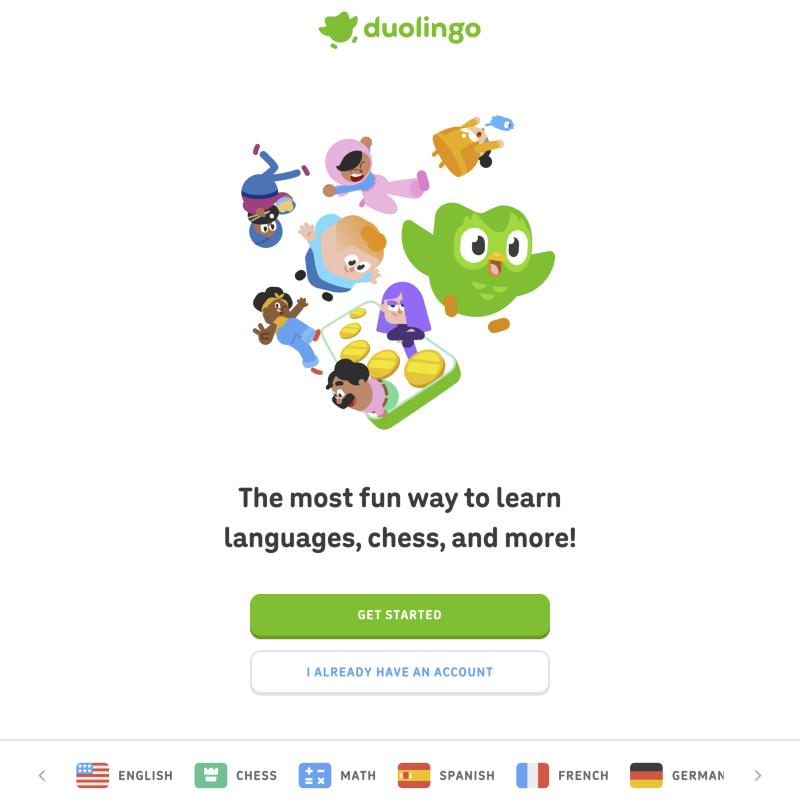
What I saw. The first row of the homepage picker reads: English, Chess, Math, Spanish, French, German. The same navigation lists 40 languages plus those two. The headline says “languages, chess, and more!” and the page title says “the world’s most popular way to learn”.
Why it matters. Brand architecture is visible in the smallest control. A picker that mixes subjects and languages quietly tells users that Duolingo is a list of courses. The bigger promise is a daily learning habit, and a subject-first picker would say so.
I could be wrong because a flat list is fast, and Duolingo may have tested and kept it. Chess and math sit first because they are new and Duolingo wants them seen.
The fix · my proposal, not Duolingo’s
Pick a situation, then turn the dial. The copy is mine, written to show what each setting should sound like. Push the dial too far playful in a serious situation and see the damage.
Arrow keys move the dial. Duo’s everyday voice sits at the left.
The test: does it touch someone’s money, job, safety or data? If yes, start at Calm or Serious, never Playful.
Keep Feather Green for fills, illustration and the logo. Add a deeper green for text and links, and put dark text on green buttons.
Feather Green #58CC02
Fills, illustration, big shapes, the 3D button
Get startedLabel: #042C60 on green 6.55 : 1
Feather Deep #398501 (proposed)
Headlines, links, small text on white
Get startedText on white 4.64 : 1 · white label on deep 4.64 : 1
Choose what to learn, then which one. Subjects sit one level above languages, so chess and math stop competing with Spanish.
What I’d do first
Turn the four settings into a one-page playbook. Run a tabletop exercise with the social, comms and leadership teams on a fake bad-news day.
Measure Time from incident to a signed human response, in the rehearsal.
Ship Feather Deep for text and links, keep Feather Green for fills. Check every headline and label against 4.5:1.
Measure Share of text elements passing AA, by page.
Compare the flat row with a subject-first picker in a tree test, then a live split.
Measure Course starts by subject, and time to first start.
Method and limits
Duolingo® and the Duolingo owl are trademarks of Duolingo, Inc., shown only to identify the subject of commentary. This study is not affiliated with or endorsed by Duolingo.
The Brand Starter Kit gives a business its positioning, identity, voice and a live site in three weeks, with a fixed price.